Women’s Rights in Afghanistan Under Taliban Rule
By Qundeel Hassan Senior Journalist & Human Rights Activist
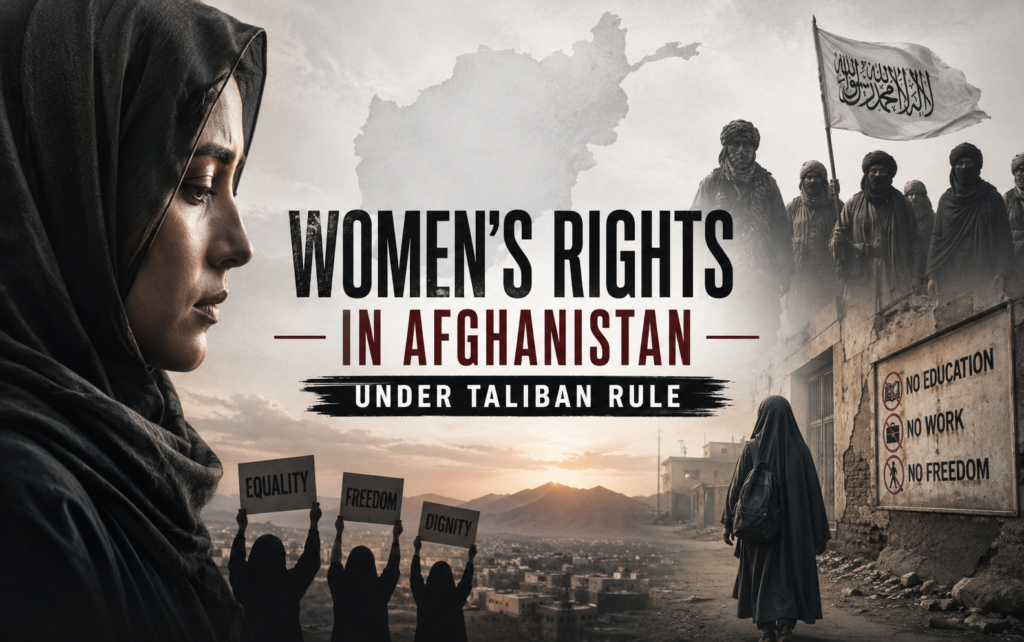
Introduction
Human rights are the basic freedoms and protections that every person should enjoy regardless of gender, religion, nationality, or social status. Among these rights, women’s rights are essential because equality and dignity cannot be achieved when half of a society is denied education, employment, freedom of movement, and participation in public life.
The situation of women and girls in Afghanistan has become one of the world’s most serious human-rights concerns since the Taliban returned to power on 15 August 2021. Since then, the Taliban authorities have introduced and enforced restrictions that have severely limited women’s access to education, employment, healthcare, political participation, and everyday public life. UN Women describes Afghan women and girls as facing the most severe women’s-rights crisis in the world.
Education: A Right Taken Away
Education is a fundamental human right and an important foundation for a country’s development. However, under Taliban rule, girls have been prevented from continuing their education beyond primary levels, while women have also been excluded from universities.
By 2025, UN Women reported that girls had been barred from secondary education for four years and that women and girls remained excluded from high schools and universities.
This restriction affects much more than individual students. When girls cannot attend school, they lose opportunities to become teachers, doctors, journalists, lawyers, scientists, and community leaders. Afghanistan also loses the skills and potential of an entire generation.
Restrictions on Employment
Women’s right to work has also been severely restricted. Many Afghan women have been prevented from working in government institutions, NGOs, and other sectors. Restrictions have also affected women working with the United Nations and humanitarian organizations.
UN Women has reported that Afghan women are barred from most jobs, while UN human-rights officials have warned that restrictions on women are deepening the country’s social and humanitarian crisis.
Employment is not only a source of income. For many women, it provides independence, dignity, professional identity, and the ability to support their families. Removing women from the workforce therefore has serious economic and social consequences
Freedom of Movement and Public Life
Women’s freedom of movement has also been restricted. In many parts of Afghanistan, women face requirements and limitations that make it difficult to travel or participate independently in public life.
These restrictions can prevent women from accessing education, employment, healthcare, and other essential services. Amnesty International has reported that women and girls have faced restrictions on freedom of movement, expression, education, employment, and political participation.
Women have also been pushed out of political and public decision-making. A society cannot fully represent its people when women are prevented from having a meaningful voice in decisions affecting their lives.
Healthcare and the Right to Health
Restrictions on women’s education and employment have also created serious consequences for healthcare. The shortage of female medical professionals can make it more difficult for women and girls to receive appropriate medical care.
A 2026 UN human-rights report highlighted concerns about the right to health of Afghan women and girls and described Taliban rule as involving a widespread and systemic attack on their rights.
The problem is especially serious in a country where cultural and social restrictions can make access to healthcare more difficult when women cannot freely travel or work with healthcare providers.
Violence, Fear, and Discrimination
Human rights are not limited to education and employment. Women also have the right to live free from violence, discrimination, intimidation, and arbitrary restrictions.
UN human-rights officials have repeatedly expressed concern about the treatment of Afghan women and girls. In February 2026, the UN High Commissioner for Human Rights called for an end to the persecution of women and girls in Afghanistan.
The cumulative effect of these policies can create an environment in which women feel excluded from society and unable to make important decisions about their own lives.
Impact on Afghan Society
The restrictions on women do not affect women alone. They affect families, communities, and the future of Afghanistan.
When girls cannot receive an education, the country loses future professionals. When women cannot work, families can lose important sources of income. When women cannot participate in public decision-making, society loses valuable perspectives.
The World Bank has noted that Afghanistan has faced severe economic disruption since the Taliban takeover, while UN agencies continue to warn about the country’s humanitarian and social challenges.
Protecting women’s rights is therefore not only a question of equality. It is also essential for Afghanistan’s economic recovery, healthcare system, education system, and long-term development.
Afghan Women Continue to Resist
Despite these restrictions, Afghan women and girls have not simply disappeared from public life. Many continue to seek education, support their families, work where possible, and speak out for their rights.
UN Women has emphasized the resilience and courage of Afghan women and girls despite the restrictions imposed on them. Their determination demonstrates that the desire for education, dignity, equality, and freedom cannot easily be erased.
What Can the International Community Do?
The international community has an important role in protecting the rights of Afghan women and girls. Governments and international organizations can:
- Demand the restoration of girls’ and women’s access to education.
- Support Afghan women-led organizations and civil society.
- Provide humanitarian assistance without discriminating against women.
- Support healthcare programs that ensure women can receive medical treatment.
- Continue documenting human-rights violations.
- Ensure Afghan women have a meaningful role in international discussions about Afghanistan.
- Hold authorities responsible for violations of internationally recognized human rights.
International engagement should also ensure that Afghan women themselves are included in discussions about their country’s future. UN experts have stressed the importance of meaningful participation by Afghan women leaders and gender-justice activists.
Conclusion
Women’s rights in Afghanistan are a major human-rights issue of our time. Since the Taliban returned to power in 2021, women and girls have faced severe restrictions on education, employment, movement, healthcare, political participation, and other fundamental freedoms.
The situation demonstrates that human rights cannot be protected selectively. Education, freedom, equality, dignity, and participation are rights that belong to every person.
Afghan women should not be viewed only as victims. They are students, teachers, doctors, journalists, professionals, mothers, activists, and leaders. Their voices and abilities are essential to Afghanistan’s future.
The struggle for women’s rights in Afghanistan is therefore not simply a struggle for women. It is a struggle for human dignity, equality, and the future of an entire society.
References
- United Nations Human Rights Office (OHCHR), Afghanistan’s human rights situation continues to deteriorate dramatically, 2026.
- UN Women, State of Women’s Rights in Afghanistan.
- OHCHR, Afghanistan: Taliban’s gender oppression and international funding cuts, 2026.
- UN Women, Press briefing: Four years since the Taliban takeover of Afghanistan, 2025.
- Amnesty International, Human Rights in Afghanistan.