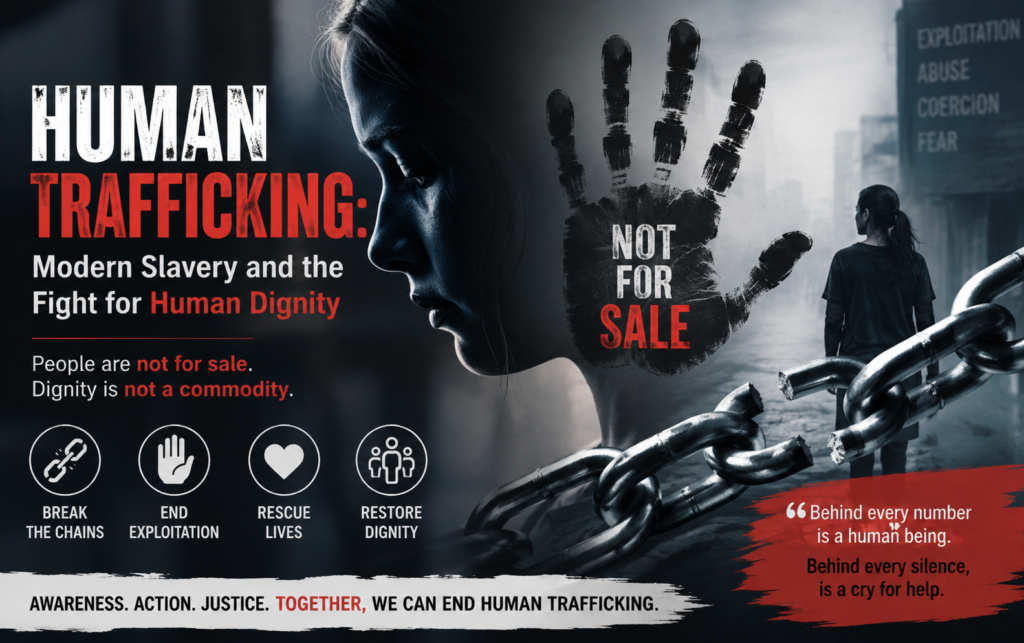
Human Trafficking: Modern Slavery and the Fight for Human Dignity
By Qundeel Hassan Senior Journalist & Human Rights Activist
Introduction
Human rights are based on the principles of freedom, equality, dignity, and justice. Every person has the right to live free from exploitation, violence, and forced labor. Yet millions of people around the world continue to experience one of the most serious violations of these rights: human trafficking.
Human trafficking is often described as modern slavery because traffickers control and exploit people for profit. Victims may be forced into labor, sexual exploitation, domestic servitude, forced marriage, or other forms of abuse. Although trafficking is a global problem, people living in poverty, conflict, displacement, or other vulnerable circumstances are often at greater risk.
What Is Human Trafficking?
Human trafficking involves the recruitment, transportation, transfer, harboring, or receipt of people through methods such as force, threats, coercion, deception, or abuse of vulnerability for the purpose of exploitation.
Trafficking does not always involve crossing an international border. A person can be trafficked within their own city, province, or country.
Traffickers frequently take advantage of poverty, unemployment, lack of education, displacement, and people’s hopes for a better life. They may promise victims well-paid jobs or safe migration, only to later use threats, debt, violence, or deception to control them.
Human Trafficking as Modern Slavery
Modern slavery takes different forms, but its central feature is the exploitation and control of human beings.
Some victims are forced to work in agriculture, construction, factories, restaurants, mines, or private homes. Others are subjected to sexual exploitation. Children can also become victims of forced labor, criminal exploitation, or other forms of trafficking.
The exploitation of a person for financial gain is not simply a criminal issue—it is a direct attack on human dignity. A person who is threatened, controlled, or forced to work against their will is being denied fundamental freedoms.
Human Rights Violations
Human trafficking violates several fundamental human rights, including:
- The right to life and security
- The right to freedom from slavery and forced labor
- The right to freedom from torture and cruel, inhuman, or degrading treatment
- The right to freedom and personal security
- The right to fair and just working conditions
- The right to equality and non-discrimination
- The rights of children to protection from exploitation
The Universal Declaration of Human Rights makes clear that no person should be held in slavery or servitude and that everyone has the right to freedom and security.
Why Are People Vulnerable to Trafficking?
Human trafficking is closely connected with social and economic inequality. People facing poverty or unemployment may accept risky employment opportunities because they have few alternatives.
Conflict and displacement can also increase vulnerability. Refugees and displaced people may lack legal protection, stable income, or access to reliable employment. Children separated from their families can face particularly serious risks.
Gender inequality is another important factor. Women and girls may be targeted for sexual exploitation, forced labor, domestic servitude, or forced marriage.
However, trafficking can affect people of all genders, ages, nationalities, and backgrounds.
The Role of Technology
Technology has created new opportunities for traffickers to recruit and exploit victims. Social media, online advertisements, messaging platforms, and other digital tools can be used to approach vulnerable people, advertise fraudulent employment, or control victims.
At the same time, technology can also help authorities, journalists, civil society organizations, and communities identify trafficking networks and protect potential victims.
Therefore, the fight against trafficking increasingly requires both traditional law-enforcement methods and effective responses to online exploitation.
The Fight for Human Dignity
Combating human trafficking requires more than arresting traffickers. Victims must be treated as people whose rights have been violated rather than as criminals or illegal migrants.
Governments should strengthen laws against trafficking, investigate criminal networks, protect victims, and ensure that survivors can access healthcare, legal assistance, education, shelter, and employment opportunities.
International cooperation is also essential because trafficking networks can operate across borders. Countries need to share information, strengthen protection for migrant workers, and cooperate in investigating and prosecuting traffickers.
Communities also have an important role. Public awareness can help people recognize fraudulent job offers, unsafe recruitment practices, and signs of exploitation.
Protecting Victims and Survivors
A human-rights-based response must place victims at the center of anti-trafficking efforts.
Survivors may experience physical and psychological trauma long after escaping exploitation. They may also face discrimination, poverty, fear of traffickers, or difficulties returning to normal life.
Effective protection should therefore include:
- Safe accommodation and immediate protection.
- Medical and psychological support.
- Access to legal assistance
- Protection from retaliation by traffickers.
- Education and vocational opportunities.
- Assistance with safe reintegration into society.
- Compensation and access to justice where appropriate.
Supporting survivors is not charity. It is part of protecting their fundamental human rights.
What Can Be Done?
The fight against human trafficking requires action at every level.
Governments should strengthen legislation, improve victim protection, investigate trafficking networks, and address corruption.
Businesses should ensure that workers throughout their supply chains are not subjected to forced labor or exploitation.
Schools and communities can educate young people about trafficking risks, unsafe migration, and deceptive recruitment.
Individuals can remain cautious about suspicious job offers and report suspected exploitation to appropriate authorities or trusted organizations.
International organizations and civil society groups can provide protection, research, awareness programs, and support for survivors.
Conclusion
Human trafficking is one of the most serious human rights challenges of the modern world. It turns human vulnerability into profit and strips individuals of their freedom, safety, and dignity.
Calling trafficking modern slavery reminds us that slavery has not disappeared—it has changed its forms. The fight against trafficking must therefore be a fight for human dignity, equality, freedom, and justice.
Ending human trafficking will require stronger laws, international cooperation, responsible businesses, public awareness, and—most importantly—a commitment to protecting victims and survivors. Every person deserves to live free from exploitation and fear. Protecting that right is not only a legal responsibility; it is a shared responsibility to humanity.
References
- United Nations, Universal Declaration of Human Rights.
- International Labour Organization (ILO), resources on forced labour and modern slavery.
- United Nations Office on Drugs and Crime (UNODC), resources on human trafficking and migrant smuggling.
- International Organization for Migration (IOM), resources on human trafficking and migrant protection.
- United Nations Human Rights Office (OHCHR), resources on human trafficking and human rights.