Balochistan: Enforced Disappearances and the Right to Life
By Qundeel Hassan Senior Journalist & Human Rights Activist
Introduction
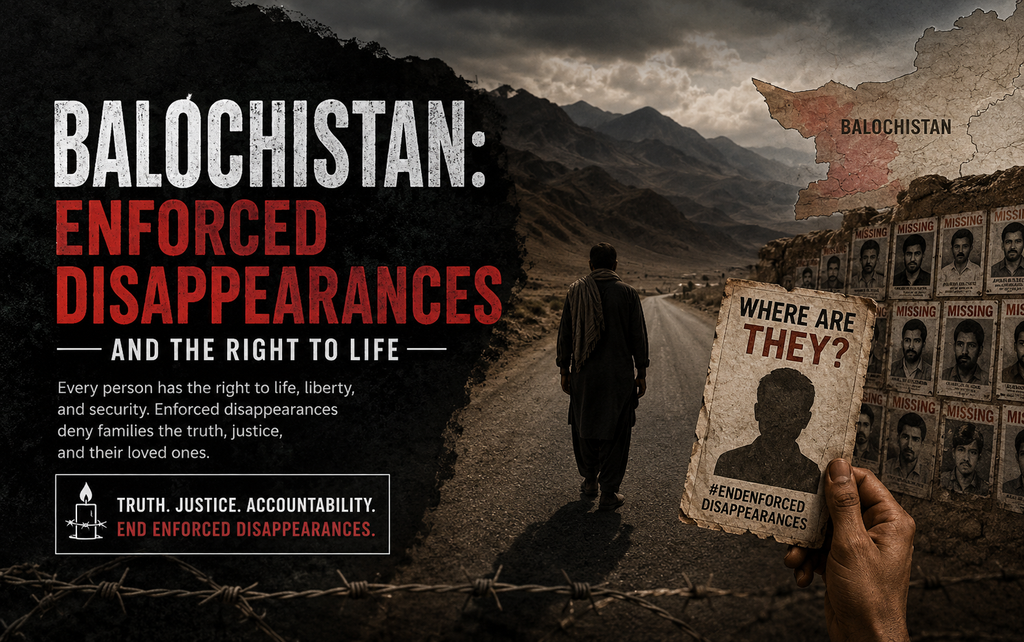
The right to life is one of the most fundamental human rights. Every person has the right to live with dignity, security and protection from arbitrary violence. Enforced disappearance, in which a person is taken into custody or otherwise deprived of liberty and the authorities deny or conceal their whereabouts, places that right in grave danger. It also violates a person’s rights to liberty, due process and protection from torture.
In Balochistan, enforced disappearances have remained one of the most serious and controversial human-rights issues in Pakistan. Families have repeatedly reported that relatives—including students, activists and other civilians—have disappeared after allegedly being taken away by security or law-enforcement personnel. Human-rights organizations continue to document cases of disappearances and alleged extrajudicial killings in the province.
A Continuing Human Rights Crisis
The scale of the problem remains difficult to establish because different institutions and organizations use different definitions, sources and methods of counting cases. Pakistan’s Commission of Inquiry on Enforced Disappearances reported that it had received 10,636 cases from March 2011 through September 2025, of which 8,986 had been disposed of and 1,650 remained under investigation. The government says that cases are investigated and resolved through the Commission’s procedures.
At the same time, independent Balochistan-focused human-rights organizations continue to report new cases. One such organization documented 234 alleged enforced disappearances in February 2026, including nine teenagers, while another report documented 65 cases in March 2026. These figures are allegations reported by the organizations and should not automatically be treated as independently verified totals.
The continuing disagreement over numbers makes independent investigation and transparent documentation particularly important.
The Right to Life
Enforced disappearance is directly connected to the right to life. When a person is taken away and their location is concealed, families may have no information about whether the person is alive, injured, being detained or has died.
The danger becomes even greater when disappeared people are later found dead. In May 2026, for example, the reported recovery of the body of a young man in Kech who had been missing for months prompted allegations of custodial killing from rights groups and renewed concerns about the safety of disappeared persons. Such allegations require impartial investigation and should be established through credible evidence and due legal process.
International human-rights principles require states to protect life and investigate credible allegations of unlawful killings. A government cannot protect the right to life merely by preventing ordinary crime; it must also ensure that people in state custody are accounted for and protected.
The Suffering of Families
The consequences of enforced disappearance extend far beyond the missing person. Families are often left in a state of uncertainty. Parents may spend years searching for their children, spouses may wait for missing partners, and children may grow up without knowing what happened to a parent.
This uncertainty can cause severe emotional, social and economic hardship. Families may also face difficulties obtaining information, pursuing legal remedies or holding responsible individuals accountable.
Amnesty International and other human-rights organizations have repeatedly called on Pakistan to end enforced disappearances, investigate those responsible, and provide truth, justice and reparations to victims and their families.
Security Concerns and Human Rights
Balochistan has also experienced serious violence by armed separatist groups and other militant organizations. Civilians and security personnel have been killed in terrorist attacks, and the government has a legitimate responsibility to protect the population and maintain security. For example, a 2026 attack on a train in Balochistan killed at least 24 people and injured more than 50, demonstrating the severe security challenges facing the province.
However, counterterrorism measures must operate within the law. Security concerns cannot justify arbitrary detention, torture, enforced disappearance or unlawful killing. People suspected of crimes should be arrested according to law, informed of the allegations against them, given access to legal representation and brought before an independent court.
Protecting national security and protecting human rights should not be viewed as opposing goals. Effective security depends on public trust, and public trust depends on accountability and respect for the law.
The Need for Accountability
Pakistan has established the Commission of Inquiry on Enforced Disappearances to investigate cases of missing persons. The Commission’s existence represents an institutional attempt to address the issue, but human-rights organizations have criticized its effectiveness and called for stronger mechanisms for accountability.
A meaningful response should include:
- Immediate disclosure of the whereabouts of detainees.
- Independent investigations into allegations of enforced disappearance and unlawful killings
- Due process and fair trials for anyone suspected of involvement in criminal or militant activity
- Protection for families, lawyers, journalists and human-rights defenders who seek information about missing persons.
- Accountability for officials or other individuals responsible for unlawful detention, torture or killing.
- Compensation and other forms of reparation for victims and their families.
- Transparent public reporting about investigations and their outcomes.Immediate disclosure of the whereabouts of detainees.
- Independent investigations into allegations of enforced disappearance and unlawful killings.
- Due process and fair trials for anyone suspected of involvement in criminal or militant activity.
- Protection for families, lawyers, journalists and human-rights defenders who seek information about missing persons.
- Accountability for officials or other individuals responsible for unlawful detention, torture or killing
- Compensation and other forms of reparation for victims and their families.
- Transparent public reporting about investigations and their outcomes.
Conclusion
The issue of enforced disappearances in Balochistan is not simply a political or security question—it is fundamentally a human-rights issue. Every person has the right to life, liberty, dignity and protection under the law.
The state’s responsibility to combat terrorism and armed violence is real, but that responsibility must be exercised within the framework of human rights and due process. When people disappear without explanation, families are denied answers and society loses confidence in the rule of law.
The protection of the right to life requires more than promises. It requires transparent investigations, accountability, judicial oversight and guarantees that no person can be taken away and simply vanish without explanation. Ending enforced disappearances would therefore be an important step toward restoring justice, dignity and public trust in Balochistan.
References
- Pakistan’s Commission of Inquiry on Enforced Disappearances.
- Amnesty International, Pakistan: Failure to Address Enforced Disappearances.
- International Commission of Jurists, analysis of Pakistan’s Commission of Inquiry on Enforced Disappearances.
- Human Rights Council of Balochistan, reports on alleged disappearances and killings in 2026.
- Amnesty International, documentation concerning enforced disappearances in Pakistan.