Pakistan’s Press Freedom Under Pressure as New Media Restrictions Draw Criticism
By Qundeel Hassan Senior Journalist & Human Rights Activist
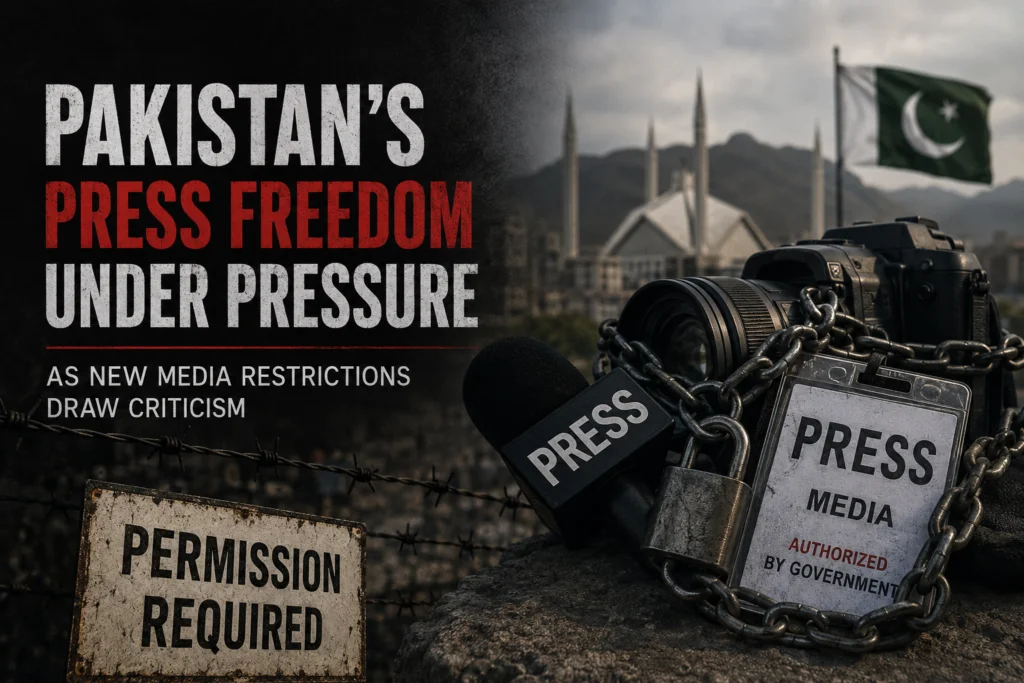
ISLAMABAD, August 7, 2026 — Pakistan’s record on human rights has come under renewed scrutiny after the government introduced new restrictions affecting journalists working for international media organizations.
Under the new guidelines, Pakistani journalists, producers and other local staff working with foreign media outlets must obtain government permission before travelling to or reporting from areas outside Islamabad, Karachi and Lahore. They are also required to register with the authorities. The restrictions have prompted criticism from journalists’ organizations and human-rights groups, which fear that they could make independent reporting more difficult.
The move comes amid heightened tensions and security concerns in several parts of the country, including Pakistan-administered Kashmir. Authorities have not publicly provided a detailed explanation for extending the restrictions to Pakistani nationals working for foreign media. Critics, however, argue that security concerns should not be used to unnecessarily restrict the public’s access to information.
Freedom of expression and access to information are fundamental human rights. Journalists play an important role in informing citizens, investigating allegations of wrongdoing and reporting on issues that affect communities. When journalists face restrictions on where and how they can work, concerns arise that important stories may remain unreported.
Human-rights organization ARTICLE 19 has urged the Pakistani government to end what it describes as an escalating crackdown on freedom of expression and to protect journalists, lawyers and human-rights defenders.
The latest restrictions are part of wider concerns about press freedom in Pakistan. Human Rights Watch has reported that journalists in the country have faced harassment, arbitrary arrests, enforced disappearances and physical attacks, while some media organizations have resorted to self-censorship. The organization has also raised concerns about laws governing online speech and their effect on journalists and critics.
At the same time, the Pakistani government says it has taken steps to strengthen human-rights protection. In July, the Ministry of Human Rights launched the National Action Plan on Human Rights 2026, describing it as a national framework intended to improve the promotion and protection of human rights and address implementation gaps.
The contrasting developments highlight an important challenge for Pakistan. While the government has announced initiatives aimed at strengthening human-rights protections, journalists and civil-society organizations continue to raise concerns about restrictions on freedom of expression.
For ordinary citizens, press freedom is not simply a matter concerning journalists. Independent reporting enables people to make informed decisions and hold public institutions accountable. A healthy democracy depends on citizens being able to receive and discuss information without unnecessary interference.
As Pakistan faces political, economic and security challenges, the debate over press freedom is likely to remain an important human-rights issue. The government faces the difficult task of addressing genuine security concerns while ensuring that restrictions do not undermine fundamental freedoms.
The coming weeks will show whether the new media rules remain in place or are reconsidered following criticism from rights groups and journalists. For now, the controversy has once again placed freedom of expression at the centre of Pakistan’s human-rights debate.