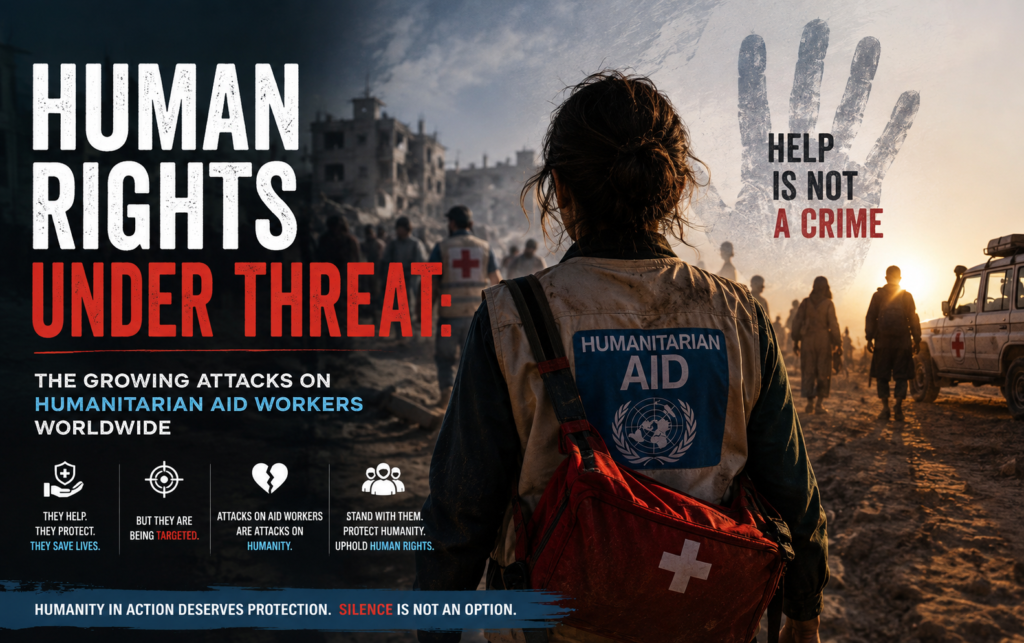
Human Rights Under Threat: The Growing Attacks on Humanitarian Aid Workers Worldwide
By Qundeel Hassan Senior Journalist & Human Rights Activist
Introduction
Humanitarian aid workers are among the people who enter the world’s most dangerous places to help others. They provide food to families facing hunger, medical care to the injured, shelter to displaced communities, and protection to people affected by war and natural disasters. Yet, while humanitarian crises are increasing, the people delivering lifesaving assistance are increasingly becoming victims themselves.
The growing violence against humanitarian workers is not only a security problem; it is a serious human rights and international humanitarian law concern. Aid workers must be able to carry out their duties without being attacked, kidnapped, detained, threatened or killed.
The situation has become particularly alarming in 2025 and 2026. According to the United Nations Office for the Coordination of Humanitarian Affairs (OCHA), 907 aid workers were killed, injured or kidnapped in 2025, compared with 833 in 2024. Of those, 350 were killed, making 2025 the second-deadliest year on record for humanitarian workers.
What Is Happening to Humanitarian Workers?
Humanitarian workers operate in conflict zones, refugee camps, areas affected by natural disasters and regions suffering from extreme poverty. Their work often requires them to travel through dangerous areas and interact with communities on all sides of a conflict.
However, attacks against them are increasing. Humanitarian personnel are being exposed to shootings, airstrikes, armed attacks, kidnapping, detention and other forms of violence.
The United Nations has warned that the growing use of armed drones is creating new dangers for aid workers. In 2025, attacks included incidents involving humanitarian convoys and facilities in places such as Sudan, Ukraine and the Democratic Republic of the Congo.
These attacks can have consequences far beyond the individual victims. When aid workers cannot safely reach communities, food deliveries may stop, medical services can be suspended and vulnerable people can be left without essential assistance.
Gaza: A Major Example of the Danger
The Gaza conflict has become one of the clearest examples of the dangers faced by humanitarian and medical workers.
According to recent UN-related reporting, 186 humanitarian workers were killed in Gaza in 2025, making it the deadliest location for humanitarian personnel for the third consecutive year.
Humanitarian organizations have repeatedly raised concerns about the safety of their personnel and the ability to deliver assistance to civilians. Attacks affecting aid workers also create fear among local communities and make it more difficult for organizations to provide essential services.
The deaths of humanitarian workers should remind the international community that people delivering assistance are not legitimate targets. Their role is to protect and assist civilians affected by conflict.
Sudan and Other Conflict Zones
Sudan is another major example of the dangers facing humanitarian personnel. The continuing conflict has created enormous humanitarian needs while making humanitarian operations increasingly dangerous.
In South Sudan, the situation has also deteriorated. Recent UN figures indicate that at least 36 humanitarian workers and contractors had been killed during 2026, already exceeding the total recorded for the whole of 2025. More than 450 incidents involving violence against aid personnel and humanitarian assets were reported between January and July 2026.
These figures demonstrate a disturbing pattern: the places where people most urgently need humanitarian assistance are often becoming the places where aid workers face the greatest danger.
Human Rights and International Humanitarian Law
The protection of humanitarian workers is closely connected to international humanitarian law. During armed conflicts, civilians and humanitarian personnel are entitled to protection.
Humanitarian workers do not fight wars. Their mission is to provide assistance to people affected by conflict, regardless of their nationality, religion, ethnicity or political position.
Attacking humanitarian personnel can prevent essential assistance from reaching civilians and may violate international humanitarian law. The United Nations has emphasized that attacks on humanitarian personnel interrupt food deliveries, healthcare, protection and other lifesaving services.
Therefore, protecting aid workers is also a way of protecting the human rights of the millions of people who depend upon humanitarian assistance.
Local Aid Workers Face Particular Risks
An important part of this crisis is often overlooked: many humanitarian workers are local people serving their own communities.
National staff frequently remain in dangerous areas even when international personnel are evacuated. They may be providing assistance to their own neighbors while experiencing the same conflict, displacement, hunger and insecurity as the people they are trying to help.
Recent analysis found that thousands of national aid workers have been victims of attacks since 2021.
Their contribution deserves greater international recognition. Humanitarian organizations and governments must ensure that local staff receive adequate security measures, training, insurance, mental-health support and protection.
The Consequences for Civilians
When humanitarian workers are attacked, civilians suffer too.
An attack on an aid convoy can prevent food from reaching hungry families. The killing of medical personnel can reduce access to emergency healthcare. The detention of humanitarian workers can interrupt assistance programs. Fear can force humanitarian organizations to withdraw from areas where people desperately need help.
The result is a dangerous cycle:
Conflict → Attacks on aid workers → Suspension of humanitarian operations → Less assistance → Greater suffering among civilians
For this reason, the protection of humanitarian workers should not be viewed as a separate issue from civilian protection. The two are directly connected.
What Should Be Done?
The international community must take stronger action to protect humanitarian personnel.
sonnel.
1. Respect International Humanitarian Law
Governments and armed groups must respect international humanitarian law and protect humanitarian personnel and facilities.
2.Investigate Attacks
Attacks against humanitarian workers should be properly investigated. Where crimes have occurred, those responsible should face appropriate accountability.
3.Protect Local Staff
National humanitarian workers must receive the same serious attention to safety and protection as international personnel.
Guarantee Humanitarian Access
Parties to conflicts should allow humanitarian organizations to safely reach civilians who need food, water, medicine and shelter.
5.Improve Security Measures
Aid organizations need adequate resources for protective equipment, communications, evacuation plans and security training, particularly in active conflict zones
6.Maintain Humanitarian Funding
Funding shortages can make humanitarian operations even more difficult. Governments and international donors should provide reliable funding so that organizations can maintain essential services while investing in staff safety.
A Human Rights Responsibility
The growing attacks on humanitarian workers represent a broader crisis of respect for human dignity. Aid workers are often the last people willing and able to reach communities trapped by war, displacement, famine and disaster.
When they are attacked, the consequences reach far beyond the individual victim. Entire communities can lose access to food, healthcare, shelter and protection.
The international community therefore has a responsibility to ensure that humanitarian workers can perform their duties safely and independently.
Conclusion
Humanitarian workers dedicate their lives to helping people during some of humanity’s darkest moments. They work in war zones, disaster areas and humanitarian emergencies because millions of people depend on them.
Yet the rising number of attacks against aid workers shows that the world is failing to adequately protect those who protect others.
The figures from 2025 are a serious warning: 907 humanitarian workers were killed, injured or kidnapped in a single year, while 350 lost their lives.
On World Humanitarian Day 2026, the message should be clear: humanitarian workers must not become targets. Protecting them means protecting the civilians they serve.
Humanitarian action is built on the principle that every human life has value. Respecting that principle requires not only honoring those who have lost their lives, but also taking concrete action to ensure that those who continue to provide assistance can do their work safely.
Protecting humanitarian workers is not simply an act of compassion—it is a fundamental human rights responsibility.
References
- United Nations Office for the Coordination of Humanitarian Affairs (OCHA), World Humanitarian Day 2026.
- United Nations, World Humanitarian Day.
- Reuters, Attacks on aid workers hit record high in 2025, UN says, 19 August 2026.
- World Health Organization, World Humanitarian Day 2026.
- Aid Worker Security Database, Major attacks on aid workers: Summary statistics.